
Heritage Bank Stadium: The Gold Coast Venue and Its Many Names
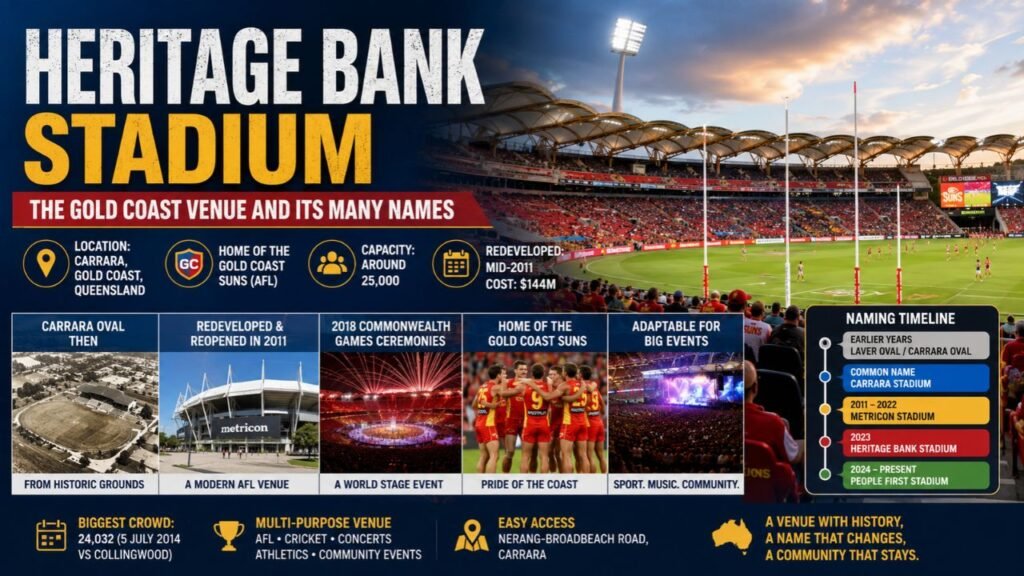
To all those who follow Australian rules football, or have ever wondered where a Gold Coast Suns match is being played: sports venue names can get very confusing. The best example being Heritage Bank Stadium. Over the years, Carrara’s ground on Queensland’s Gold Coast has been known by a number of names, and only briefly but memorably in 2018 was it known as Heritage Bank Stadium. From where the stadium is, to who named it and how many fans it can hold while what has happened there over time, this guide explains why searches on Heritage Bank Stadium still result in plenty of listings today. Where Is Heritage Bank Stadium? Located in Carrara, an inner suburb of the Gold Coast off Nerang-Broadbeach Road and within the city’s sports precinct, Heritage Bank Stadium. Its neighbours include Gold Coast Sports and Leisure Centre and the Carrara Indoor Stadium, creating a cluster of venues for all things from basketball to athletics. Locally, it’s simply known as the ground “Carrara”, a moniker that stuck through every sponsorship change. The Queensland government owns the stadium and leases it to a sister company of Gold Coast Football Club, which manages and operates it day-to-day. And that’s important because it helps to understand why the venue is so strongly identified with that city’s AFL club. A Quick Look at the Venue Detail Information Location Carrara, Gold Coast, Queensland Main Use Australian rules football (AFL) Home Club Gold Coast Suns Redevelopment Cost Around $144 million Reopened Mid-2011 Designer / Builder Populous / Watpac Typical AFL Capacity About 25,000 Map Out Carrara Oval To A Modern Stadium As the current building suggests, the site has a longer history. Grounds formerly known as Carrara Oval and Laver Oval, the venue hosted baseball, cricket, and rugby league long before the AFL arrived. It was the home of the Gold Coast Clippers baseball team in 1989 and 1990, as well as the Gold Coast Cougars when they returned to play baseball at it in the early 1990s. The ground was used by a rugby league side called the Gold Coast Chargers in the mid-1990s, and the Gold Coast Titans played their inaugural season there in 2007. The major pivot moment was the AFL’s decision to expand into the Gold Coast. The ground was redeveloped with a total cost of about $144 million into a modern purpose-built facility and reopened in mid-2011 for the then-new Suns franchise. This transformed what was a dilapidated ground then into the venue most will think of when picturing Heritage Bank Stadium today. The Naming Timeline This is where things become complicated. Naming rights deals are why the same stadium can appear each year with a completely different name attached to it, and a fan who learned of their 19th-century venue as one thing might scratch his or her head upon seeing something else on a ticket. Period Name Earlier years Laver Oval / Carrara Oval Common non-commercial name Carrara Stadium 2011 to 2022 Metricon Stadium 2023 Heritage Bank Stadium 2024 to present People First Stadium The name Heritage Bank Stadium was only used for one season, 2023, before the venue changed its name to the current one, according to a listing on the league ground. From February 2023, the ground adopted the name of Heritage Bank Stadium following a new commercial naming rights partnership, according to one venue guide. Since the name was used only briefly, if you do not even any more aged websites, ticket sales ads and match reports still recommended him in this way, which is part of what makes up so ubiquitous in searches. Also Read: Maharashtra Cricket Association Stadium | M. Chinnaswamy Stadium Capacity and Configuration When quoting the capacity of Heritage Bank Stadium, however, it is not as simple as saying a number because different sources quote this figure differently. The AFL capacity is listed as being around 25,000 – entirely seated. The stadium’s own details show a capacity of just under 27,500 but with scope to increase to around 40,000 as and when demand warrants it in the future Larger concert configurations of up to 50,000 and cricket layouts for about 21,000 capacity are also mentioned on reference listings. The sensible reading of all this is the stadium is a medium sized AFL ground which and has a capacity that varies depending on the season and seating, field layout. When building your plans around a specific match or concert: check the figure for that event, not a single quoted number. Photos of Heritage Bank Stadium Records and Big Crowds The biggest ticketed attendance at the ground came on 5 July 2014, with a crowd of 24,032 attending a fixture between the Gold Coast Suns and Collingwood. Among the venue’s biggest turnouts are 23,302 for a match against the same opponents in 2011. Those figures demonstrate the extent to which Collingwood’s travelling support helps fill the ground given Gold Coast’s own home crowds have frequently been much, much lower. Crowds at the naming stadium in 2016 remained relatively small by comparison. About 13,600 rocked up to their Round 1 clash with Sydney in the first home match of the season while a subsequent home game against Geelong brought around 13,100 fans through the gates. Both figures are well below the ground’s approximate 25,000 capacity — so those home matches were hardly full. The 2023 Season at the Ground And it’s only worth taking a closer look at because 2023 was the only season that name could apply to Heritage Bank Stadium. With four defeats in five games, the Suns started slowly and the season was a rough one. Coach Stuart Dew was sacked halfway through his sixth year in charge, replaced by Steven King for the final seven matches of the season. One of the highlights at the ground was a 67-point thrashing of Hawthorn in Round 17, this being one of only a handful of bright spots in a challenging year. This is helpful context for anyone reviewing match