The IPL auction is an ascending-bid process in which franchises assemble or strengthen squads within rules on spending, player categories and squad composition. A team may retain certain players before an auction, use the Right to Match option in the auction where permitted, and then compete for available players from a fixed purse. The regulations for the 2025–27 cycle gave franchises considerable flexibility, but that flexibility came with limits intended to preserve competitive balance.
The auction purse and the wider salary cap
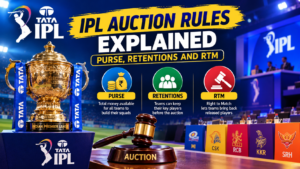
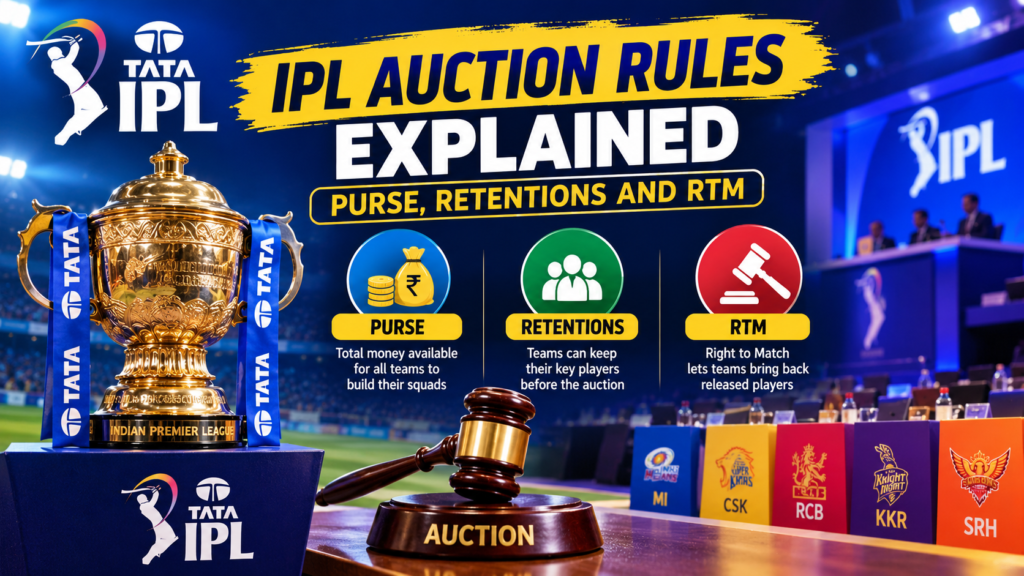
An auction purse is the amount a franchise has available to secure players through retention and auction purchases. It is not simply a cheque book for a single day: the cost of retaining players affects how much can be spent when bidding begins. That is why a decision to keep an established player is also a decision about the funds available for the rest of the squad.
For IPL 2025, the IPL Governing Council set the auction purse for each franchise at INR 120 crore. The Council also distinguished the auction purse from the total salary cap. The latter consists of the auction purse, incremental performance pay and match fees. The announced total salary cap was INR 146 crore for 2025, INR 151 crore for 2026 and INR 157 crore for 2027.
This distinction matters when reading auction headlines. A player’s contracted auction amount belongs to the squad-building calculation, while the salary-cap framework also accounts for other specified payments. The Governing Council introduced a match fee in the 2025–27 cycle: each playing member, including the Impact Player, receives INR 7.5 lakh per match in addition to the contracted amount.
Retentions: keeping players before bidding begins
Retention allows a franchise to hold on to players from its existing squad rather than putting every player into the auction pool. It offers continuity: a team can protect core performers, leadership figures or specialist players who fit its tactical plan. But it also limits the money that can be directed towards open-market bidding.
Under the IPL Governing Council’s 2025–27 regulations, a franchise could retain a total of six players from its existing squad through a combination of direct retentions and Right to Match options. This is important because “six retentions” did not mean six players necessarily had to be announced before the auction. A franchise could divide its allowance between pre-auction retentions and RTM choices according to its own strategy.
The six-player allowance carried category limits. A maximum of five could be capped players, whether Indian or overseas, while a maximum of two could be uncapped players. Therefore, a side could not use the full six slots exclusively on capped cricketers, and it could not build its entire retention list around uncapped players either. The structure encouraged franchises to make deliberate choices across experience levels.
What capped and uncapped status means
The regulations included a specific definition for an Indian capped player becoming uncapped. An Indian player could be treated as uncapped if, in the five calendar years before the relevant season, he had neither appeared in the starting XI in international cricket—Tests, ODIs or Twenty20 Internationals—nor held a BCCI central contract. This provision applied only to Indian players.
A player’s category can influence retention planning because the regulations limit capped and uncapped slots separately. Franchises therefore need to assess more than recent form. They must consider eligibility, the likely auction market for a player and how each decision affects the remaining slots. For broader context on how player roles, squad choices and auction outcomes can shape a season, readers may find TheCricScope useful alongside official IPL announcements.
How bidding works at the auction
The IPL auction uses an English ascending-bid format. Players are presented one at a time, and interested franchises increase the price until no other team is prepared to go higher. The final active bidder secures the player, subject to the auction rules and the franchise’s ability to accommodate the purchase within its available funds and squad requirements.
A player’s base price acts as the starting point rather than a prediction of the final fee. According to the player-auction overview on Wikipedia, players set their own starting price when applying. Once bidding begins, the competition between franchises determines the eventual value. A player can therefore be sold at base price when only one team bids, or attract repeated increases when several teams value the same skill set.
The same overview describes set bidding increments: bids rise by INR 20 lakh until the INR 1 crore mark, by INR 25 lakh after INR 1 crore and INR 2 crore thresholds, and by INR 50 lakh beyond INR 2 crore. These steps prevent bids from becoming arbitrary and allow the auctioneer to move swiftly while teams assess their remaining purse and needs.
Sold, unsold and the strategic value of timing
A player is sold when a franchise makes the highest accepted bid. If no franchise bids at the required starting level, the player is unsold. Neither result is necessarily a simple verdict on ability. An unsold outcome may reflect limited squad places, a lack of a specific role requirement or purse constraints after earlier purchases. Likewise, a high price can reflect scarcity at a particular stage of the auction as much as individual reputation.
Timing also changes the dynamics. A franchise that has already addressed its principal requirements may not challenge aggressively for later players. Another side may have funds left but few open squad slots. This is why an auction price should be read within the wider setting of a franchise’s retained players, available purse, positional needs and category limits rather than as an isolated measure of quality.
The Right to Match option
The Right to Match, commonly shortened to RTM, gives a franchise a route to reclaim an eligible former player during the auction instead of retaining that player in advance. For the 2025–27 regulations, RTM was part of the same overall six-player allowance as direct retention. Using an RTM did not create an additional retention slot.
The practical attraction of RTM is flexibility. A franchise can allow the market to establish a player’s price before deciding whether to use its matching right. This may be useful where a team wants continuity but is uncertain how strongly other franchises will bid. It also carries risk: a high auction price can make the final decision more expensive than an advance retention.
Because the IPL Governing Council allowed franchises to choose their own retention-and-RTM combination, different teams could take different routes. One could prioritise certainty through direct retention; another could reserve more options for the auction room. The key point is that RTM is not a separate, unlimited mechanism. It operates within the six-player total and the capped and uncapped limits for the cycle.
Overseas players and availability obligations
Overseas-player participation has its own regulations. For the 2025–27 cycle, an overseas player had to register for the Big Auction. If an overseas player did not register, that player became ineligible to register for the following year’s player auction. This rule connected auction participation across consecutive seasons rather than treating each registration as wholly independent.
The regulations also addressed post-auction availability. Any player who registered, was picked at the auction and then made himself unavailable before the season started would receive a ban from both the tournament and the player auction for two seasons. The rule underlined that selection at auction carries an obligation: franchises make squad and financial plans on the expectation that signed players will be available.
These provisions matter because an auction is not only a contest for talent. It is also the process through which franchises create workable squads for a full season. Availability, player category, role balance and spending capacity all affect decisions made in seconds when the auctioneer calls for the next bid.
Squad building beyond headline purchases
The player auction is often remembered for expensive signings, but successful planning depends on the full group. Wikipedia’s player-auction overview states that an IPL team can have a maximum of 25 players, with limits on Indian and overseas players. Those roster boundaries mean franchises must consider depth in every department rather than spend too much of their purse or space on one position.
A team may seek opening options, middle-order batting, pace variations, spin resources, wicketkeeping cover and all-round balance. Retentions can solve some of those requirements early, while the auction fills gaps. An expensive acquisition can be justified if the player addresses a scarce need, but lower-cost purchases are equally important when a squad needs backup and tactical flexibility.
The IPL auction rules for 2025–27 combine certainty and competition. Retentions and RTM options protect continuity, the purse shapes spending discipline, and ascending bids reveal how franchises value available players. Understanding those connected rules makes the auction easier to follow: every raised paddle reflects not only a player’s appeal, but also a team’s remaining funds, slots and long-term plan.