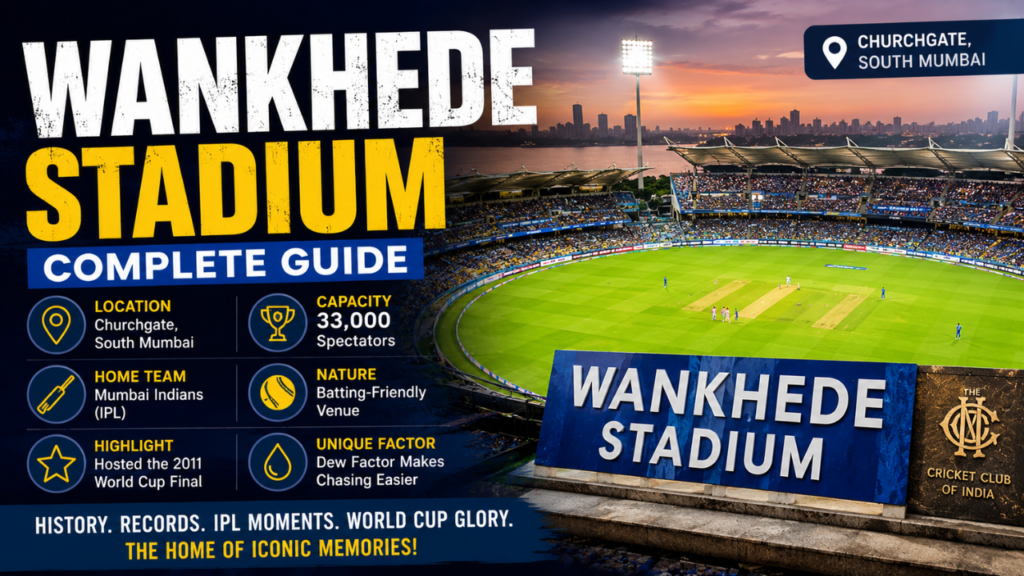
There are not many cricket grounds around the world that have the heft of Wankhede Stadium. Nestled in the heart of South Mumbai, with hot breeze from Arabian Sea wafting over its stands, this ground has been witness to some defining moments of the game – a World Cup win that brought a billion people to a standstill and a legend’s tearful walk back to the pavilion for the last time.
Given cricket is a religion in this city, it is The Religion’s holiest of addresses. It is also, in purely cricketing terms, one of the most savagely batter-friendly grounds anywhere in the sport: a venue where scores mount at speed, sixes are treated to regular bounces over the rope into the stands, and chasing sides have learnt to back themselves with genuine conviction.
Wankhede Stadium Overview
| Feature | Details |
| Stadium Name | Wankhede Stadium |
| Location | Churchgate, Mumbai, Maharashtra |
| Established | 1974 |
| Named After | Sheshrao Krishnarao Wankhede (former BCCI President) |
| Seating Capacity | Approximately 33,000 |
| Operated By | Mumbai Cricket Association (MCA) |
| Home Teams | Mumbai Indians (IPL), Mumbai Ranji Team |
| Bowling Ends | Garware Pavilion End, Tata End |
| Pitch Type | Red soil; true bounce; batting-friendly |
| Floodlights | Yes |
| Formats Hosted | Test, ODI, T20I, IPL, First-Class |
Location: Wankhede Stadium
The Story Behind the Ground
The muse is, in a sense, popcorn cricket politics grown and yet going to become something altogether larger than life. The early 1970s saw a spat between the Cricket Club of India, which held sway over the Brabourne Stadium, and the Bombay Cricket Association over ticket allocations for international matches. Instead of prolonging their battle, the Association president, Sheshrao Krishnarao Wankhede, took the courageous step of moving to construct an entirely new ground.
Designed by architect Shashi Prabhu, construction started in 1974 and, within a period of just under thirteen months, was completed. The urgency proved worthwhile, as the venue was completed in time to stage its first Test match against West Indies in January 1975. Lloyd was piling on the runs, including an unfathomable 242 not out in that first Test win by 201 runs for the visitors. India would secure its inaugural Test win here two years later, against New Zealand, and the ground soon established itself as Mumbai’s principal cricket ground, christened in memory of a man whose crucial decisiveness had made it possible.
Also Read: M. Chinnaswamy Stadium | Narendra Modi Stadium
Pitch Report
That reputation as one of the most reliable batting surfaces in Indian cricket long predates the opening, and that remains intact going into 2026. It is laid on a red soil base and genuinely true and consistent bounce, the kind that enables batters to read the pace well enough to play their shots with conviction, rather than caution. The high scores here are a product of multiple factors. The square used to be one of the shorter ones on the IPL circuit, but it is a fast outfield that is still quick in humid coastal air long before reaching its finish.
There is something for the bowlers, especially in the first few overs when it is under lights and before night dew comes into play, when a seamer gets good swing off the surface. However, that opportunity vanishes quickly as it gets easier for batsman to play their shots the deeper they get into batting. The function of spin, historically, has been somewhat constrained, the real bounce gives none of the grip that slow bowlers depends on, but wily wrist spinners can still be a nuisance if they are clever about their changeups.
The behaviour translates into three simple shifts across the formats
- Tests: Batters reign in long sessions as balls turn soft, but cloudy mornings still deliver seamers a sincere helping hand against the new ball.
- ODIs: An even surface but still slightly favours batters, with totals of 280+ common in completed innings.
- T20Is and IPL matches: Some of the most batting-friendly conditions in the shot, where match-winning totals of 180 seldom occur in isolation.
IPL Records
This ground has had perhaps the highest amount of explosive batting that any venue in IPL history. It is the venue that has held more IPL matches than any other in history, and the numbers mirror unlike the type of cricket it well known for.
| Record | Detail |
| Highest Team Total (1st Innings) | 235 |
| Lowest Team Total | 67 – KKR vs Mumbai Indians, 2008 |
| Highest Individual Score | 133* – AB de Villiers (RCB) vs MI, 2015 |
| Highest Successful Chase | 198/7 – Mumbai Indians vs Punjab Kings, 2019 |
| Most Wickets at Venue | Lasith Malinga – 28 wickets (22 matches) |
| Most Sixes at Venue | Rohit Sharma – 37 sixes |
| Highest Wicket Partnership | 206 – Chris Lynn & Gautam Gambhir (KKR), 2017 |
| Average First Innings Score | 166 |
| Total IPL Matches Hosted | 125+ |
| Teams Chasing – Win % | 54% |
AB de Villiers’ 133 not out off just 59 balls (with 19 fours and 4 sixes) against Mumbai Indians in 2015 is still one of the iconic individual innings ever played here, standing unchallenged as the highest IPL score at the venue for almost a decade.
Test and ODI Records
This ground has a pretty rich history over the longer formats, apart from the time it has hosted in the IPL with its Test debut dating back to 1975.
| Record | Detail |
| Highest Test Individual Score | 333 – Chris Gayle (West Indies) vs India, 2011 |
| First Test Match | India vs West Indies, January 1975 |
| Tendulkar’s 100th Century | Vs Bangladesh, Test, 2012 |
| Tendulkar’s Farewell Test | November 2013, vs West Indies |
| 2011 World Cup Final | India defeated Sri Lanka to win the title at home |
Sachin Tendulkar, the chapter with arguably the most emotive hallmarks on these grounds, it was here in 2012 that he reached his final cricketing pinnacle, scoring his historic 100th international century against Bangladesh and bowing out of the sport ever present from this very canvas less than a year after, in November 2013.
Two years prior, it had been the mound at which MS Dhoni sealed India’s 2011 World Cup triumph with that six over long-on, a moment forever replayed in highlight reels.
Toss Trends and Match Outcomes
A key reason the toss holds real tactical relevance here is by virtue of how dew influences play under IPL lights in the second half of a season. Especially at night, when the temperature drops and dew settles on the outfield, it makes life noticeably more difficult for bowlers, spinners or otherwise.
This has now regularly skewed the balance in favour of the side batting second, and in recent seasons, captains have opted to chase more frequently, having won the toss. Chasing teams have won roughly 54% of completed matches as per statistics, and while this would only be a slight margin in terms of numbers, it will be enough to influence strategy before the match even starts.
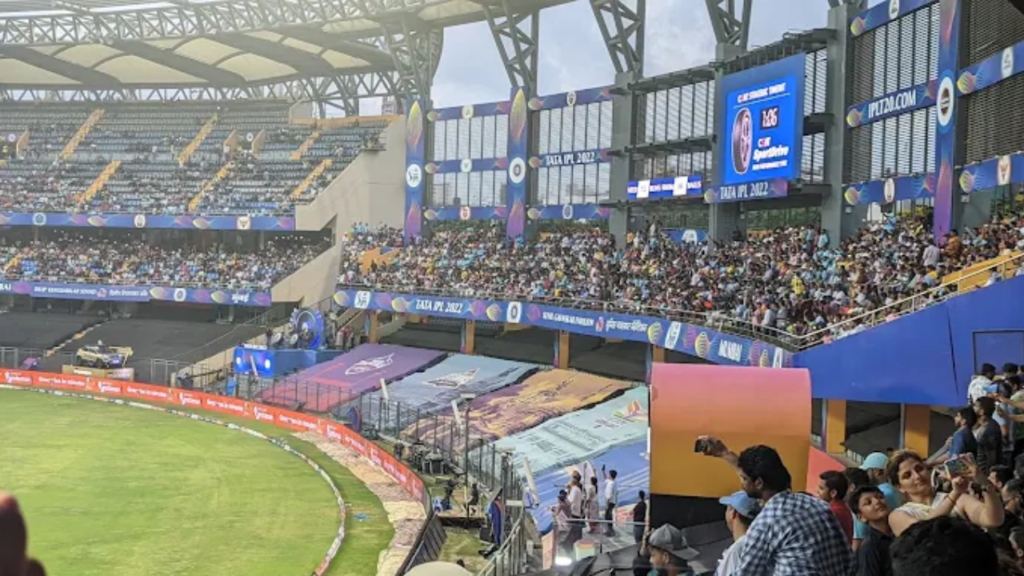
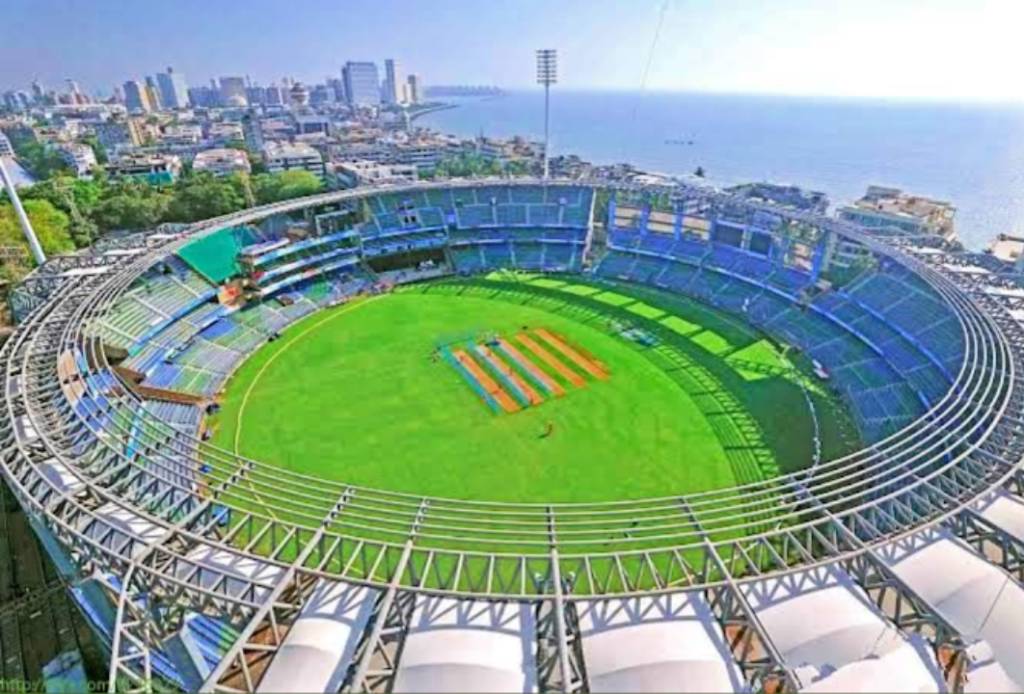
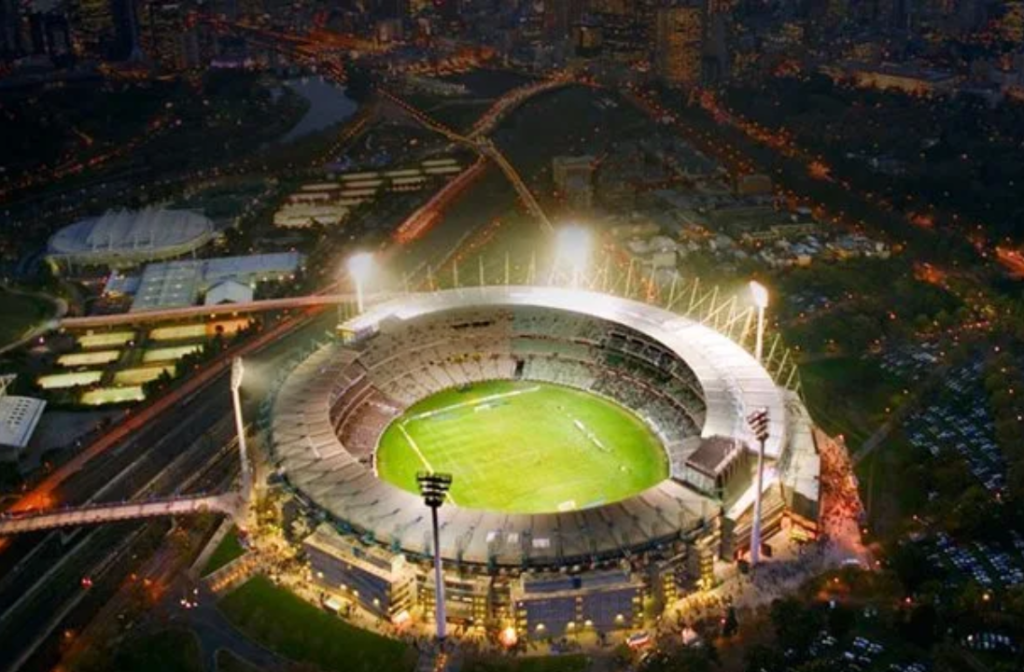
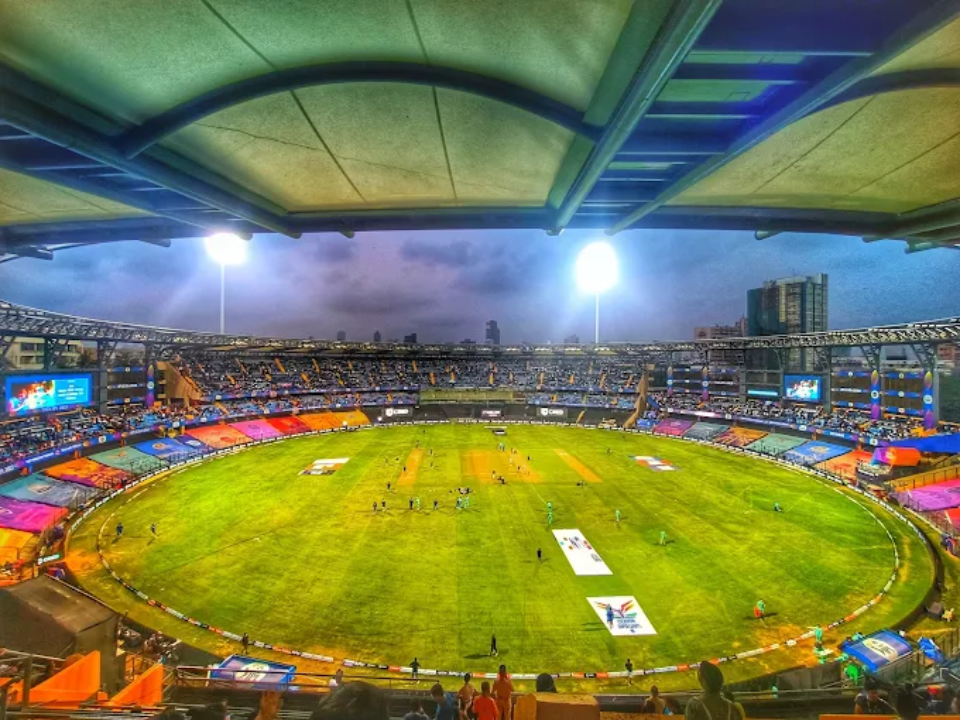
Wankhede Stadium Photos
How This Venue Compares to Other IPL Grounds
| Stadium | Pitch Nature | Avg. T20 Score | Chasing Edge |
| Wankhede Stadium | Very batting-friendly | 166-185 | High |
| M. Chinnaswamy Stadium | Extremely batting-friendly | 168-181 | Very High |
| Eden Gardens | Balanced | 160-180 | Medium |
| Narendra Modi Stadium | Balanced to bowling-friendly | 150-170 | Medium |
| M.A. Chidambaram Stadium | Spin-friendly | 140-165 | Low |
That would go quite comfortably towards making this one of the most free-scoring venues on the IPL circuit, only being bettered in terms of raw run-scoring capability by Bengaluru’s Chinnaswamy, but worse than all other major Indian venues.
IPL 2026 at Wankhede
It is the home ground of Mumbai Indians for more than a decade, and remains integral to Mumbai’s 2026 campaign. Historically a good batting track, this season has kept to its aggressive batting character with numerous home games that have posted first innings total well in excess of 180. Mumbai Indians had a somewhat mediocre run through the broader tournament, but have leaned on both the familiarity and home-fan make-up of the ground, an aspect that has mattered in their history with tight finishes here.
In 2026, just as in earlier events, the dew element at night has played its part, with captains calling correctly and choosing to chase in a large majority of day-night matches.
Also Read: Uday Saharan | Shivam Dube
How to Reach It
The stadium is located in the Churchgate region of South Mumbai, in easy walking distance to the famous Marine Drive promenade and well served by the city’s transport system.
- Near Railway Station: Churchgate, about a five minute walk away from the gates
- Flight: Chhatrapati Shivaji Maharaj International Airport about 25-30 km away (depending on traffic)
- By Road: Closely accessible via Marine Drive & South Mumbai’s main thoroughfare with limited parking on match days hence use Public transport is strongly advised
Conclusion
Wankhede Stadium is not just another cricket field, it also represents the emotional bittersweet farewell of Tendulkar, Dhoni’s World Cup-winning six and Mumbai’s undying spirit for the game. Season after season, it continues to be a venue that rewards aggressive batting and provides cricket fans with high-scoring, exhilarating matches. This ground will continue to be exactly what it has always been, one of the truest tests of a batter’s nerve, and one of the most loved cricket grounds anywhere in the world, going into IPL 2026 and beyond.
Frequently Asked Questions (FAQs)
1. Where is Wankhede Stadium located?
Wankhede Stadium is situated in Churchgate, South Mumbai, just off Marine Drive.
2. Who is Wankhede Stadium named after?
It was named after former Bombay Cricket Association president Sheshrao Krishnarao Wankhede.
3. How many seats are there in Wankhede Stadium?
The capacity of the stadium is around 33,000.
4. Which IPL team plays at Wankhede Stadium?
Wankhede is the home ground of Mumbai Indians.
5. What is the highest IPL score by an individual at Wankhede Stadium?
AB de Villiers 133* in 2015 off 59