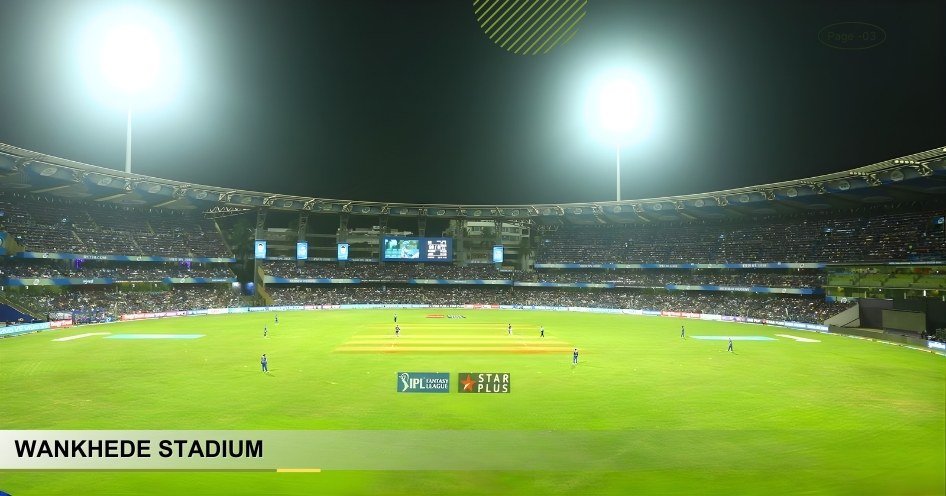
Wankhede Stadium is a cricket stadium in the Indian city of Mumbai, India, The stadium now has capacity of 33,108 (down from approximately 45,000 before the upgrade) and was first established in 1974.
Wankhede Stadium was established in 1974 and opened the next year by the Mumbai Cricket Association (MCA) through disputes with the CCI regarding allocation of tickets for Brabourne Stadium. The stadium, which was named after the association’s long-time secretary Sheshrao Krushnarao Wankhede, has gone on to see some of cricket’s most iconic moments in history from across formats.
Over the years, Wankhede Stadium has conducted some of the best performances in Test cricket, ODIs, T20Is along with Indian Premier League (IPL) matches and marquee ICC events. It has a unique place in the culture of Indian cricket, having staged several World Cup matches and legendary farewells such as Sachin Tendulkar’s last Test.
History and Development
Background Wankhede Stadium was built in 1974 – and till then Test matches played in Mumbai were hosted by the Brabourne Stadium, a colonial-era ground that was established in 1937.The CCI leased the land to MCA at a nominal rent for reclaiming it using basic debris so as to upgrade the facility.The entry has been moved from Gate 2, which is near Firoz Shah Mehta Road. After the controversial India vs England Test in 1973, MCA opted to construct its own ground near Churchgate Railway Station located at South Mumbai. With construction taking a little over 13 months, the stadium was inaugurated just before the final Test of West Indies’ tour to India in 1975.
The first time the stadium hosted a Test match was in 1980, and it has been used as an international venue since then. It has been renovated several times, most recently for the final of the 2011 Cricket World Cup. This redevelopment brought improved facilities and elevated stands, with bucket seating design to have people sitting further back in the stand unlike many stadia to promote closer atmosphere, but has lessened capacity and comfort for spectators.
The stadium has several stands including the Sunil Gavaskar Stand, Sachin Tendulkar Stand, North Stand, Vijay Merchant Stand, Divecha Pavilion and Garware Pavilion. Its overhanging cantilevering roofs mean just about every seat has a clear view.
Wankhede Stadium Capacity & Structure
Wankhede Stadium was renovated in 2011 to stripped out of the original’s exhaustion with a capacity of approximately 33,000. Its capacity was closer to 45,000 before this upgrade when it still featured bench seating instead of individual bucket seats.
The stadium’s two ends are Garware Pavilion End and Tata End. It is complete with floodlight towers for day-night international cricket and lucrative T20 matches.
Although not as humongous as some of the modern-day stadiums in India, Wankhede’s small setting aids in having a raucous and electric environment particularly during bigger matches such as IPL games and World Cup fixtures.
Wankhede Stadium Pitch Report & Playing Conditions
The pitch at the Wankhede Stadium has been a batsman-friendly one down the years with good pace and bounce that makes it exciting for stroke-makers. Another reason for the extra bounce is red soil base more than any other Indian pitch. The quicks get some movement, especially in the first 10 overs that are bowled under sea breeze conditions and early morning matches promises tight first spells from fast bowlers. The pitch generally becomes easier to bat on as the game proceeds – especially in limited-overs formats. Spinners can also get help later in longer matches, but generally not as much as pacers.
In Tests, bounce and true wicket have allowed teams to lay down massive first-innings scores. In ODIs and T20 Internationals, batsmen dominate subsequently: a good batting surface with relatively short boundaries will always see high scores.
Wankhede Stadium Dimensions & Boundary Lengths
The boundaries at Wankhede Stadium are generally smaller than many other International grounds especially square of the wicket. According to several pitch reports:
The average length of the boundary is known to be 65–70 metres, while some denoted it as harring boundaries drawn up to 70–72 meters along straights.
Some records suggest that the stadium’s boundaries created a near- symmetrical circular shape, of 70m across on all sides of the playing field.
It’s small, which makes it favorable to high totals- especially in T20 and ODI cricket, and the bounce on this hard pitch gives the batters those extra milliseconds for scoring freely with an unshaken mind.
Weather Conditions & Best Time to Play
Wankhede Stadium is situated near the Arabian Sea that affects the local climate. Climate The climate of Mumbai is a tropical one, with a warm and humid season and monsoon rains.
Mumbai’s hot season lasts from March to May, with daytime temperatures frequently topping 30°C (86°F). The winter months (December to February) are pleasant with day time temperature between 25 °C and 30 °C (77 °F–86°F). The winters in Guntur show very mild to little chillness. The monsoon season — between June and September in northwestern India — ushers in heavy rainfall that can affect play, though floodlights and fast outfield drainage systems often help matches resume quickly after rain delays.
Wankhede most of the international matches, IPL matches and domestic tournaments were played between November to May due to monsoon which causes a lot interruptions in game and has favorable playing condition.
Wankhede Stadium Ticket Prices & Entry Information
Wankhede Stadium ticket prices differ substantially depending on the type of match, category of seat and importance of fixture. For international and IPL (Indian Premier League) matches, costs are usually somewhere in the region of: (approx, based on recent trend)
General Admission: ₹500–₹1,500
Mid-range Seats: ₹2,000–₹5,000
Premium / VIP Boxes: ₹6,000–₹15,000+
Corporate & Hospitality Seats: ₹20,000 and up for marquee games
Tickets can be bought from official online partners such as BookMyShow, Paytm Insider and MCA’s authorised outlets. Tickets are also available on the day at box office counters around the ground, subject to availability. Ingress usually requires a valid photo ID, and verification of a ticket; though some events do allow other forms of entry.
The electrifying atmosphere and enthusiastic crowd also mean that high-demand games — especially IPL and key World Cup fixtures — sell out quickly.
Records & Achievements
Some of the greatest performances and achievements in cricket, spanning all formats, have taken place at Wankhede Stadium.
Test Cricket Records
- Highest team total: India 631 all out (v England).
- Lowest team total: New Zealand were bowled out for 62 runs by India.
- Highest score in an innings: West Indies (Clive Lloyd) 242* not out.
- Best bowling figures: Ajaz Patel claimed 10/119 in a sensational bowling performance.
- Most runs at the ground in Tests: Sunil Gavaskar (1122) ahead of Sachin Tendulkar and Dilip Vengsarkar.
- Most Test wickets: R. Ashwin (41) followed by Anil Kumble, and Kapil Dev.
ODI & T20 Records
- Highest total: South Africa made 438/4 against India in an ODI.
- Lowest ODI total Sri Lanka: 55 all out vs India.
- Highest ODI score (individual): Glenn Maxwell scored 201 for Australia vs Afghanistan*.
- Best ODI bowling: Mohammad Shami took 7-57 for India.
- Highest T20I total: One high score to be considered is 240/3 by India vs West Indies.
- Best T20I bowling: Shivam Mavi’s 4/22.
IPL Records
- The stadium hosts the IPL side Mumbai Indians, who have won the tournament five times. In the annals of IPL:
- Highest team total: 235/1 by Royal Challengers Bangalore against Mumbai Indians.
- Lowest team total: 67 all out by Kolkata Knight Riders.
- Top individual IPL score: 133* by AB de Villiers.
- Most wins batting second: More matches have been won while chasing than defending, thanks to dew in evening games
World Cup Records
Wankhede Stadium has featured in various ICC Cricket World Cups, such as 1987, 1996, 2011 and the upcoming edition of 2023. It was most well known for the 2011 Cricket World Cup final which India won against Sri Lanka, in doing so winning in their own country.
In ODI World Cups:
- South Africa’s 438/4 in 2015 is the highest ODI total at the ground on World Cup duty.
- The chase of 293/7 between Ireland and England in World Cup games is indicative high-scoring ODI battles at this venue.
- Wankhede’s World Cup timeline is also chockfull of unforgettable innings and tactical games that tilted the course of whole tournament stories, transforming it as a cultured cricket ground.
Top 10 encounters at Wankhede Stadium
- 2011 Cricket World Cup Final: India defeat Sri Lanka by six wickets to win the World Cup at home for the first time.
- India vs England Test (16/17): India scored 631 runs, most in a Test at this ground.
- India vs New Zealand T20I, 2023: Quality high-augnished T20 victory.
- South Africa 438/4 vs India (2015 ODI) : One of the highest ODI totals at the venue.
- RCB 235/1 vs MI (IPL): Highest IPL total at Wankhede.
- MI vs RR: Chase (2023 IPL): High-voltage AC chase for dew factor.
- New Zealand 62 allout (2021/22 Test) : Lowest test team score at the venue.
- West Indies Clive Lloyd 242 (Test):* Great individual innings.
- 72 runs, T20I India 240/3 vs WI: One of the highest T20I totals at the venue.
- IPL fixtures where the last over drama defined them: Multiple MI vs CSK/RCB games in IPL history highlighting the competitive nature of the ground.
Transport & Accessibility
You can easily reach Wankhede Stadium from any part of Mumbai. It is situated close to the Churchgate Railway Station and well-connected by local trains, buses, taxis and auto-rickshaws. For fans who will travel from other cities, the distance is approximately 25 kms away from Chhatrapati Shivaji Maharaj International Airport and it can be easily accessed via taxis, ride share cabs and suburban trains.
Summary
Wankhede Stadium: Wankhede is among the most storied cricket grounds not only in India but across the world. From the scenes of dramatic Test wins and stratospheric ODI totals to a never-to-be forgotten triumph in the 2011 World Cup final - it is generational. Red-soil pitch, small boundaries, sea breeze and a boisterous crowd combine to produce exciting contests in all formats — Tests, ODIs, T20Is or IPL games.
Be it the high scoring chase under lights, or a classical Test fight, Wankhede brings that high-voltage cricket experience to millions around the world and elsewhere along with memories etched forever.