
Varanasi Cricket Stadium – Location, Capacity, Design, Facilities & Complete 2026 Guide
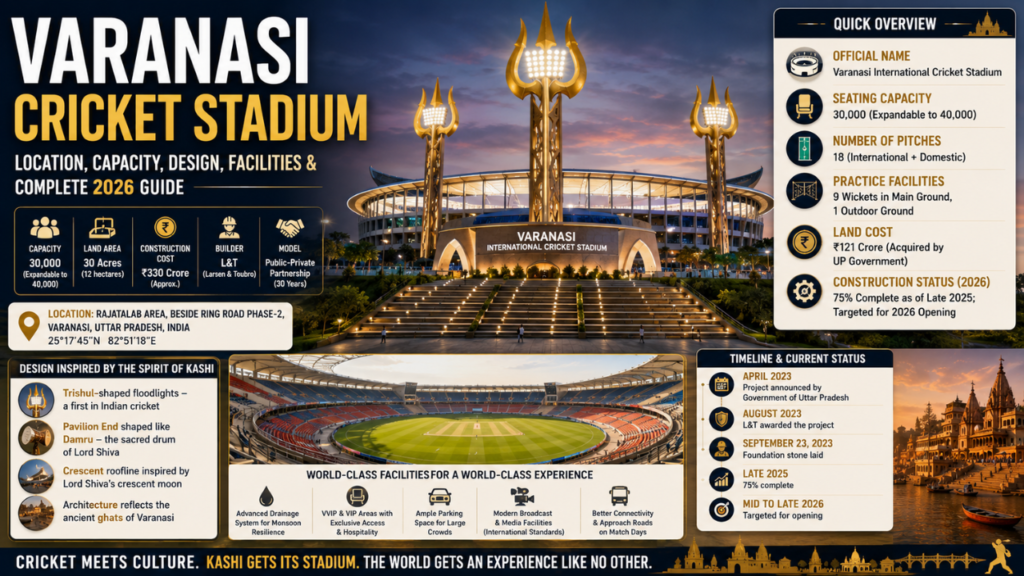
Cricket, in India, feels inevitable in cities: the energy of the sport seems to be something like air you breathe – there well might never have been a stadium for it to formally fill. Varanasi is one of those cities. The oldest living urban settlement in India, the spiritual capital of Hinduism, a city that has been attracting pilgrims and scholars, poets and traders for over three thousand years no less, now also home to India’s latest international cricket ground. The concept of the Varanasi cricket stadium is something truly unique amongst Indian sports infrastructure: a world-class facility being constructed in the midst of a city defined by an ancient identity, architected and developed to reflect that identity and not erase it. Here is the entire guide for 2026 – location, capacity, design, features and construction timeline along with everything fans need to know about Phases I-II of one of cricket’s most awaited stadium openings in Indian history. Varanasi Cricket Stadium – Quick Overview Category Details Official Name Varanasi International Cricket Stadium Location Rajatalab area, beside Ring Road Phase-2, Varanasi, Uttar Pradesh Coordinates 25°17′45″N 82°51′18″E Seating Capacity 30,000 (expandable to 40,000) Land Area 30 Acres (12 hectares) Land Cost ₹121 Crore (acquired by UP Government) Construction Cost Approximately ₹330 Crore Builder Larsen & Toubro (L&T) Operating Model Public-Private Partnership (30 years) Governing Bodies BCCI, UPCA, Government of Uttar Pradesh Tenants Kashi Rudras (UP cricket team); India national cricket team Number of Pitches 18 (international + domestic) Practice Grounds 9 wickets in main ground; 1 outdoor ground Construction Status (2026) 75% complete as of late 2025; targeted for 2026 opening Why Varanasi? The City Behind the Stadium Varanasi claims to be the spiritual capital of Hinduism, which makes India one of the biggest fan-cricket nations in the world. In a sporting venue that combines the ancient cultural weight of a city with the modern cricketing obsession in this country, it was always likely to be something ready and worth watching. Varanasi, also known as Kashi or Benares, situated on the western banks of the river Ganges, has been continuously inhabited for over 3,000 years. The city of Lord Shiva, where ancient ghats, temples, music and philosophic tradition coexist with modernity at the epicenter of a fast-growing Uttar Pradesh economy. That same Uttar Pradesh is also one of India’s biggest cricket nurseries with passionate fans throughout Lucknow, Kanpur, Meerut, Agra and Varanasi itself. Even before Varanasi cricket stadium embarks on its first match ever, in dog-whistle framing, fans are contemplating whether launches could see ICC tournaments like an ODI or T20 World Cup hosted in Kashi. The city carries with it a cultural richness that adds another layer of depth to all of its international fixtures; a match in the Test or World Cup here, for example, would represent a powerful symbolic value that most venues cannot replicate. Also Read: Sawai Mansingh Stadium | Arun Jaitley Stadium How It Started – The Origin Story of the Project The project for the cricket stadium in Varanasi was formally launched in April 2023 when the Government of Uttar Pradesh confirmed that an international cricket ground would be built in Varanasi. Its timing was also worth a mention, came as part of India’s overall assault to grow cricketing infrastructure beyond the wall-to-wall mega venues into cities with a huge appetite for the game but have hitherto been ignored by international fixtures. The stadium was awarded to Larsen and Toubro, who won the tenders in August 2023. L&T happens to be amongst the most reputed engineering and construction firms in India – involved with things like metro rail systems, airport terminals and more. Their participation lent technical credibility to the project. On the outskirts of Varanasi, the Government of Uttar Pradesh bought 30 acres near Ring Road Phase-2 in Rajatalab for ₹121 crore, while construction costs are pegged at ₹330 crore. The 30-year public-private partnership operating model means that while L&T will construct the stadium, it is also entrusted with its commercial operations for three decades, a framework that encourages high-quality construction and cost-effective long-term operations in a manner that pure government projects seldom manage. A ceremony both symbolic of the city and significant for the project was held on September 23, 2023. The Varanasi cricket stadium had a political and logistical thrust driven by the personal interest of PM Modi in the development of his Lok Sabha constituency, which has mostly kept it on track despite the usual challenges that big-city-scale construction poses to historic urban environments. Images of Varanasi Cricket Stadium Passion Meets Sports: Design and Architecture If the Varanasi cricket stadium has given its fair share of fodders during discussions to various reasons, be it its capacity or location, one of major topic for conversation around this landmark has been the architecture itself. This is no common bowl-shaped venue. All the structural elements are designed to showcase Varanasi as the land of Lord Shiva. The implementation of a trishul-shaped floodlight, a first in Indian cricket venues, is already in place. Illuminated, the gold-tipped spires of these tall trident-like towers bathe Kashi with an ambience that brings to mind both devotion and power in a manner that blends timeless tradition with modern design. The Shiva-oriented design, especially the trishul lights and crescent roof, has been praised as some of the most distinctive features at any cricket space in India. The floodlight is just a part of the design vocabulary you are trained with: None, and I mean none, of the cricket stadiums in the world – not Trent Bridge, not Eden Gardens, not the MCG, have been set up as one which is proud to be built around a singular spirit of a city. The Varanasi cricket stadium is a venue for sport and an architectural monument. Facilities and Infrastructure It will have the capacity to hold 30,000 fans and expand to 40,000 in addition to fourteen pitches for domestic and international matches outfitted with high-end drainage systems, state-of-the-art facilities and other standards-compliant