Cricket, in India, feels inevitable in cities: the energy of the sport seems to be something like air you breathe – there well might never have been a stadium for it to formally fill. Varanasi is one of those cities. The oldest living urban settlement in India, the spiritual capital of Hinduism, a city that has been attracting pilgrims and scholars, poets and traders for over three thousand years no less, now also home to India’s latest international cricket ground.
The concept of the Varanasi cricket stadium is something truly unique amongst Indian sports infrastructure: a world-class facility being constructed in the midst of a city defined by an ancient identity, architected and developed to reflect that identity and not erase it. Here is the entire guide for 2026 – location, capacity, design, features and construction timeline along with everything fans need to know about Phases I-II of one of cricket’s most awaited stadium openings in Indian history.
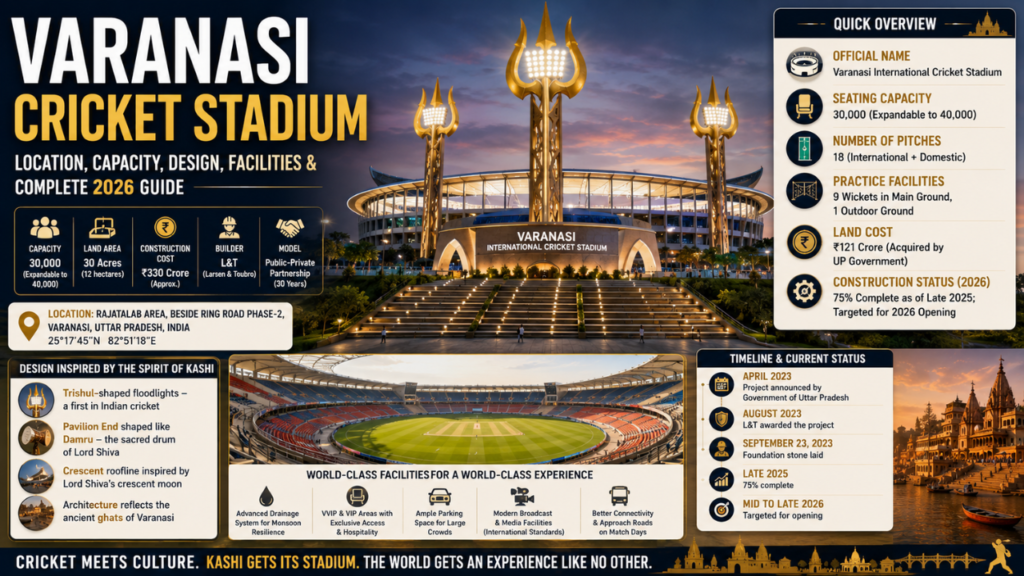
Varanasi Cricket Stadium – Quick Overview
| Category | Details |
| Official Name | Varanasi International Cricket Stadium |
| Location | Rajatalab area, beside Ring Road Phase-2, Varanasi, Uttar Pradesh |
| Coordinates | 25°17′45″N 82°51′18″E |
| Seating Capacity | 30,000 (expandable to 40,000) |
| Land Area | 30 Acres (12 hectares) |
| Land Cost | ₹121 Crore (acquired by UP Government) |
| Construction Cost | Approximately ₹330 Crore |
| Builder | Larsen & Toubro (L&T) |
| Operating Model | Public-Private Partnership (30 years) |
| Governing Bodies | BCCI, UPCA, Government of Uttar Pradesh |
| Tenants | Kashi Rudras (UP cricket team); India national cricket team |
| Number of Pitches | 18 (international + domestic) |
| Practice Grounds | 9 wickets in main ground; 1 outdoor ground |
| Construction Status (2026) | 75% complete as of late 2025; targeted for 2026 opening |
Why Varanasi? The City Behind the Stadium
Varanasi claims to be the spiritual capital of Hinduism, which makes India one of the biggest fan-cricket nations in the world. In a sporting venue that combines the ancient cultural weight of a city with the modern cricketing obsession in this country, it was always likely to be something ready and worth watching.
Varanasi, also known as Kashi or Benares, situated on the western banks of the river Ganges, has been continuously inhabited for over 3,000 years. The city of Lord Shiva, where ancient ghats, temples, music and philosophic tradition coexist with modernity at the epicenter of a fast-growing Uttar Pradesh economy. That same Uttar Pradesh is also one of India’s biggest cricket nurseries with passionate fans throughout Lucknow, Kanpur, Meerut, Agra and Varanasi itself.
Even before Varanasi cricket stadium embarks on its first match ever, in dog-whistle framing, fans are contemplating whether launches could see ICC tournaments like an ODI or T20 World Cup hosted in Kashi. The city carries with it a cultural richness that adds another layer of depth to all of its international fixtures; a match in the Test or World Cup here, for example, would represent a powerful symbolic value that most venues cannot replicate.
Also Read: Sawai Mansingh Stadium | Arun Jaitley Stadium
How It Started – The Origin Story of the Project
The project for the cricket stadium in Varanasi was formally launched in April 2023 when the Government of Uttar Pradesh confirmed that an international cricket ground would be built in Varanasi. Its timing was also worth a mention, came as part of India’s overall assault to grow cricketing infrastructure beyond the wall-to-wall mega venues into cities with a huge appetite for the game but have hitherto been ignored by international fixtures.
The stadium was awarded to Larsen and Toubro, who won the tenders in August 2023. L&T happens to be amongst the most reputed engineering and construction firms in India – involved with things like metro rail systems, airport terminals and more. Their participation lent technical credibility to the project.
On the outskirts of Varanasi, the Government of Uttar Pradesh bought 30 acres near Ring Road Phase-2 in Rajatalab for ₹121 crore, while construction costs are pegged at ₹330 crore. The 30-year public-private partnership operating model means that while L&T will construct the stadium, it is also entrusted with its commercial operations for three decades, a framework that encourages high-quality construction and cost-effective long-term operations in a manner that pure government projects seldom manage.
A ceremony both symbolic of the city and significant for the project was held on September 23, 2023. The Varanasi cricket stadium had a political and logistical thrust driven by the personal interest of PM Modi in the development of his Lok Sabha constituency, which has mostly kept it on track despite the usual challenges that big-city-scale construction poses to historic urban environments.
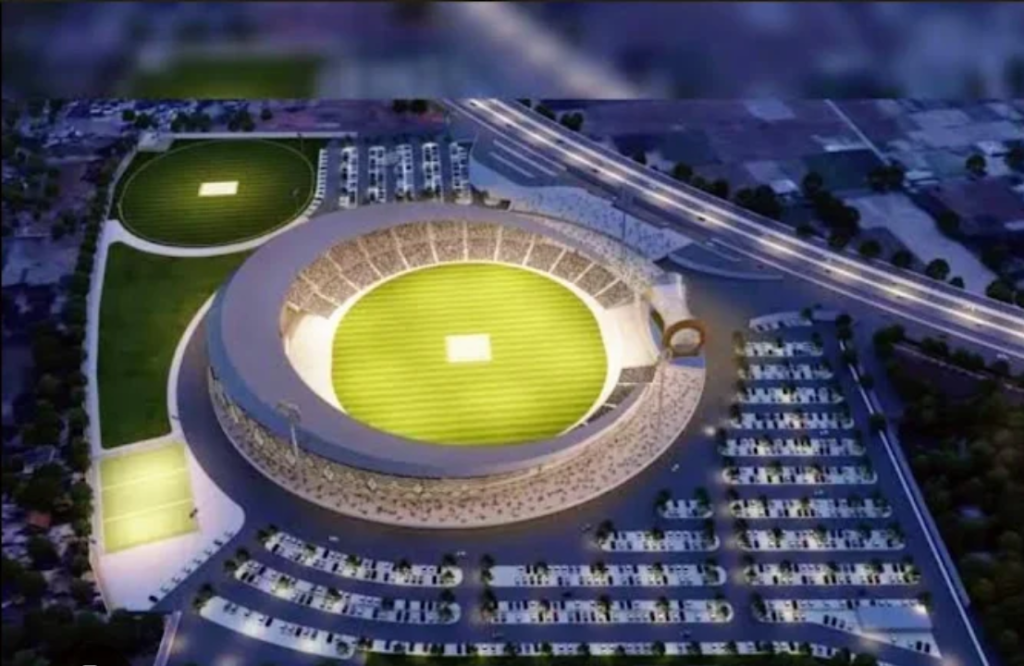
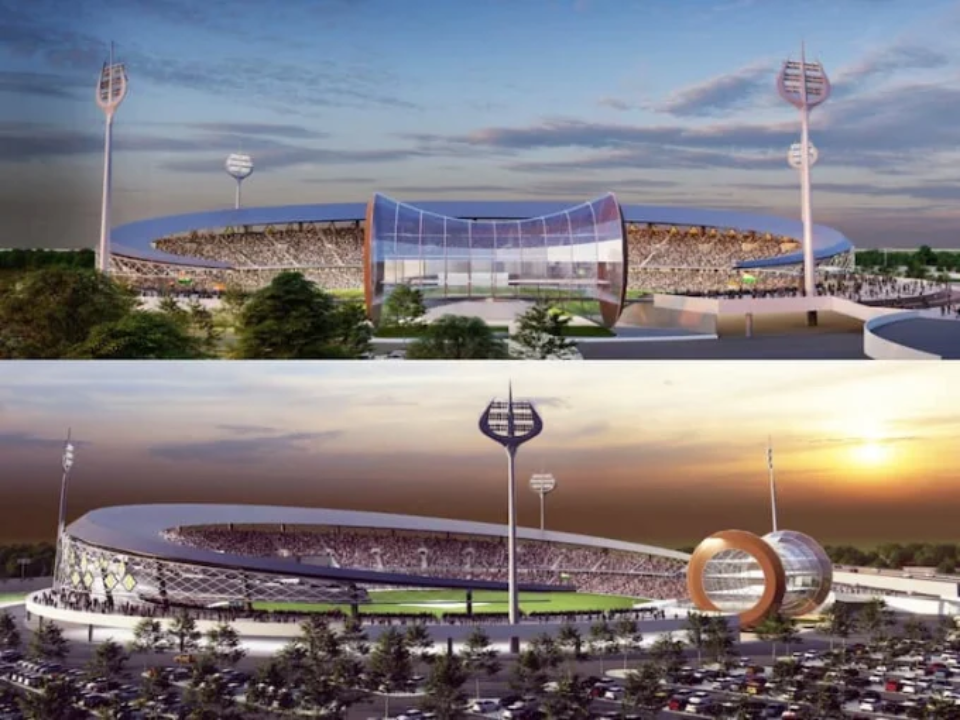
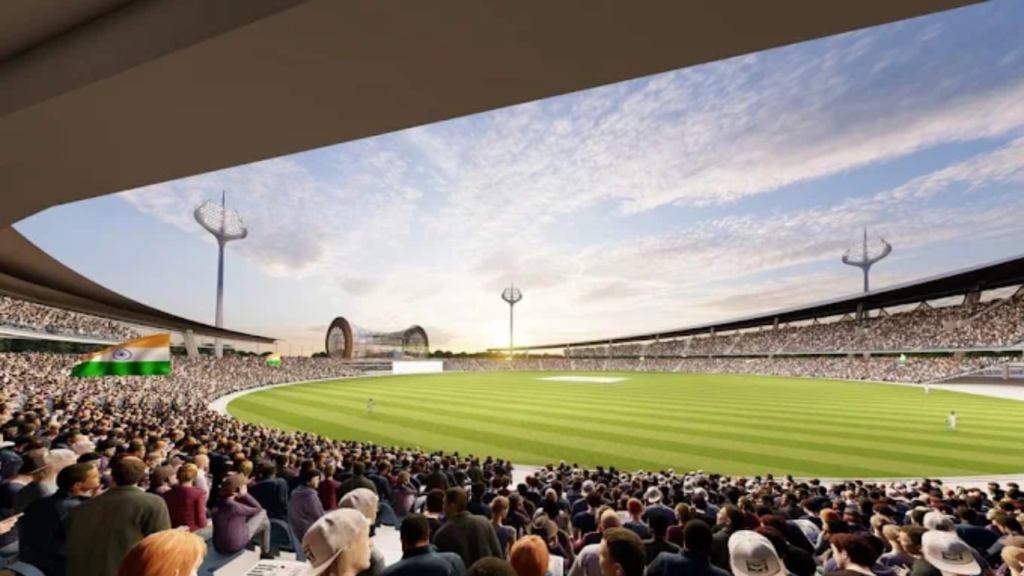
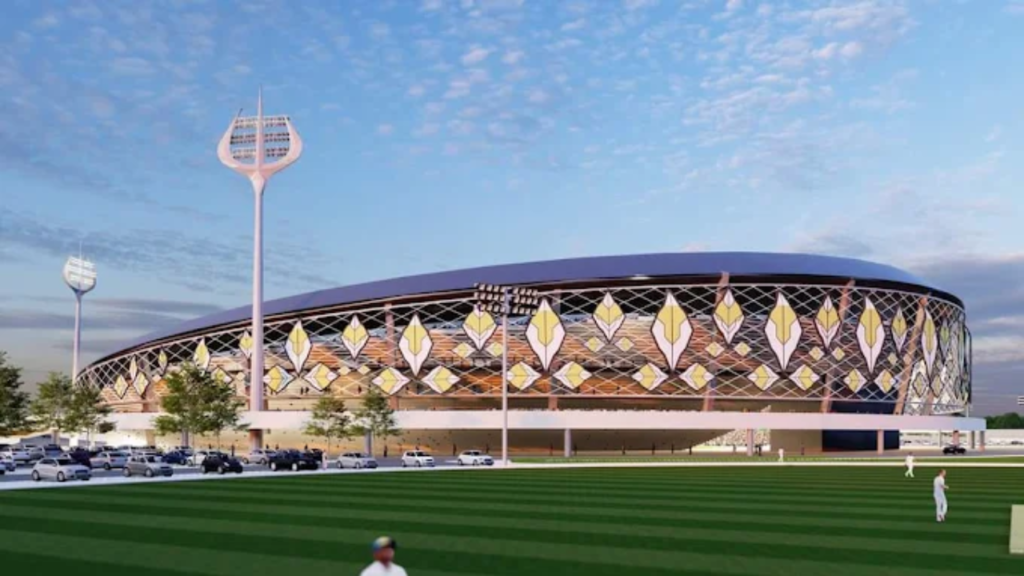
Images of Varanasi Cricket Stadium
Passion Meets Sports: Design and Architecture
If the Varanasi cricket stadium has given its fair share of fodders during discussions to various reasons, be it its capacity or location, one of major topic for conversation around this landmark has been the architecture itself. This is no common bowl-shaped venue. All the structural elements are designed to showcase Varanasi as the land of Lord Shiva.
The implementation of a trishul-shaped floodlight, a first in Indian cricket venues, is already in place. Illuminated, the gold-tipped spires of these tall trident-like towers bathe Kashi with an ambience that brings to mind both devotion and power in a manner that blends timeless tradition with modern design.
The Shiva-oriented design, especially the trishul lights and crescent roof, has been praised as some of the most distinctive features at any cricket space in India.
The floodlight is just a part of the design vocabulary you are trained with:
- The Pavilion End takes the shape of a Damru – the double-headed drum linked with Lord Shiva, which is claimed to be the genesis instrument for all sound from which the universe itself arose.
- Triangular light poles echo the Trishul – Shiva’s main symbol, trident
- The roofline resembles that of a crescent moon, as is found on the head of Shiva in classical representations
- The overarching image speaks to the ancient ghats of Varanasi – stepped platforms leading down to the river that have shaped the city and orientated its water and its pilgrimage for thousands of years
None, and I mean none, of the cricket stadiums in the world – not Trent Bridge, not Eden Gardens, not the MCG, have been set up as one which is proud to be built around a singular spirit of a city. The Varanasi cricket stadium is a venue for sport and an architectural monument.
Facilities and Infrastructure
It will have the capacity to hold 30,000 fans and expand to 40,000 in addition to fourteen pitches for domestic and international matches outfitted with high-end drainage systems, state-of-the-art facilities and other standards-compliant amenities.
Additional confirmed facility details include:
- 18 international and domestic pitches in location at the mainstream field and its concentrated amphitheaters
- 9 of practice wickets around the main ground for Pre-match preparation
- 1 Outdoor Ground Exclusively for More Training
- Also, they have an advanced drainage system to take care of the monsoon rain in Varanasi and allow ground recovery time after heavy rains.
- VVIP and VIP areas on the 2nd floor in the south office for exclusive entrance and hospitality infrastructure
- Plentiful parking areas with a capacity to accommodate for crowds set to be experienced during global fixtures
- State-of-the-art locally-built printing and broadcast facilities that meet international broadcasting standards
- Increase in frequency of public transport services on match days; better approach road upgrades coordinating with Ring Road Phase-2 (upgrades in Pipeline) to make sure access is not hampered
Construction Timeline and Current Status
By late 2025, around three-quarter of the work is done with the main structure and the stands completed along with some iconic designs including trishul-shaped floodlights. The authorities have also worked on the approach road and surrounding areas to make sure there is no hindrance in movement once matches commence.
The project has met with several delays, which have largely been blamed on a prolonged 2024 monsoon season and the difficulty of orchestrating large-scale building in a heavily layered historical urban context like Varanasi. Timelines were originally for completion by May 2026, but more recent reporting from district officials says full operational status is now pushed to mid-to-late 2026.
The ground is scheduled to be finished in time for IPL 2026. Local media has reported extensively on whether the timeline will hold exactly, with work underway picked up significantly into early 2026.
One thing is unambiguous: the scale of what is being built. An 18-pitch stadium given an iconic Shiva-inspired architectural vision, a 30-year PPP management structure, and most importantly perhaps the backing of the BCCI, UPCA and UP state government – Varanasi cricket stadium has been given every ingredient that can help it become one of India’s foremost international cricket venues.
Location: Varanasi Cricket Stadium
Projected First Matches and Beyond
Due to delays in the construction, no official fixture list has been released for the Varanasi ground as of the middle of 2026. The discussion about what could be presented in this venue has been lively.
The stadium looks primed for major global fixtures when it opens, with a 30,000-seat capacity, modern facilities and recognonized design. If timelines are maintained, early domestic games, or home games for India, can propel the ground to international limelight sooner rather than later, and could even be within reach in future World Cup cycles.
It would obviously lead to domestic UP cricket matches and the Ranji Trophy, which is the logical first step before international matches, helping ground staff calibrate pitch, drainage and operations. A super late India-England ODI or T20I series, generally with one which odds and ends on Eksana street in Lucknow alongside the neighbouring BRSABV Ekana Stadium for good measure, would be a probable very early global experience.
Further to this, the Varanasi cricket stadium has in-principle approval from the BCCI, UPCA and also the UP government, which lays the institutional framework for consideration by the ICC for future cycle conferencing a World Cup venue.
Conclusion
Varanasi cricket stadium is not merely a construction project; it goes further than that, it’s a statement of what Indian cricket is turning into and one direction, at least some are going in. It provides the country with an international venue worthy of one of its most spiritually and culturally significant cities, designed to fit in with, not supplant – what makes Varanasi, well, Varanasi.
The trishul floodlights, the Damru-shaped pavilion, the crescent roofline- these are not merely decorative afterthoughts but intentional choices that help make this the most culturally rooted cricket stadium in the world. Much like the story of Eden Gardens, when the first match finds its way here- a domestic Ranji fixture, an India bilateral ODI or eventually a World Cup game- it will not just be cricket. This will be Kashi, the forever city, finally watching the sport it was always in love with inside its own stadium.
Frequently Asked Questions (FAQs)
Q1. What is the capacity of Varanasi cricket stadium?
The cricket stadium in Varanasi will have a seating capacity of 30,000 spectators, which can be increased to 40,000.
Q2. Who is behind the Varanasi cricket stadium?
The Varanasi cricket stadium was awarded to construction giant Larsen and Toubro in August 2023. The project is being undertaken as a 30-year Public-Private Partnership (PPP) model on a Design, Build and Operate basis by L&T.
Q3. What makes the unique architecture of Varanasi cricket stadium?
Trishul-shaped floodlights at the Varanasi cricket stadium are a first in India. Once turned on, these trident-like towers throw a golden hue over the ground to symbolize Lord Shiva. Pavilion End is also conserved in the form of a Damru, and its entire architecture is reminiscent of the historic ghats & temples of the city.
Q4. What should be the number of pitches in Varanasi cricket stadium?
The Varanasi cricket stadium, which will accommodate both international and national matches, will feature a total of 18 pitches in addition to nine practice wickets on the ground itself as well as an outdoor dedicated field.
Q5. How much does the Varanasi cricket stadium project cost?
The 30-acre site was purchased by the Government of Uttar Pradesh for ₹121 crore and estimated ₹330 crore in construction cost, at a total project investment of approximately ₹450 crore.