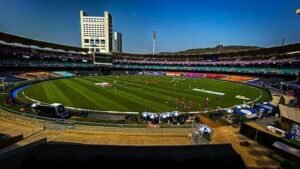
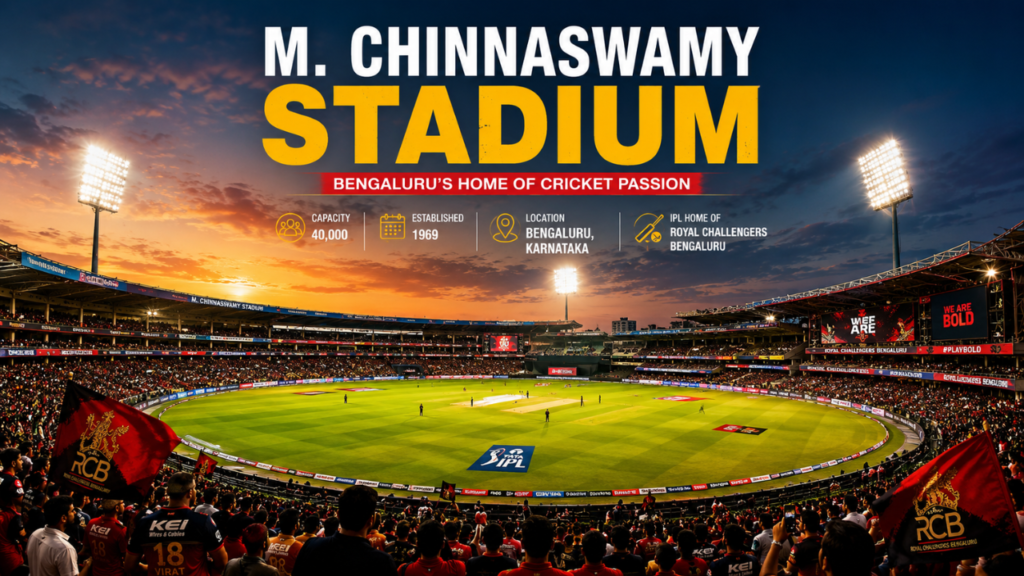
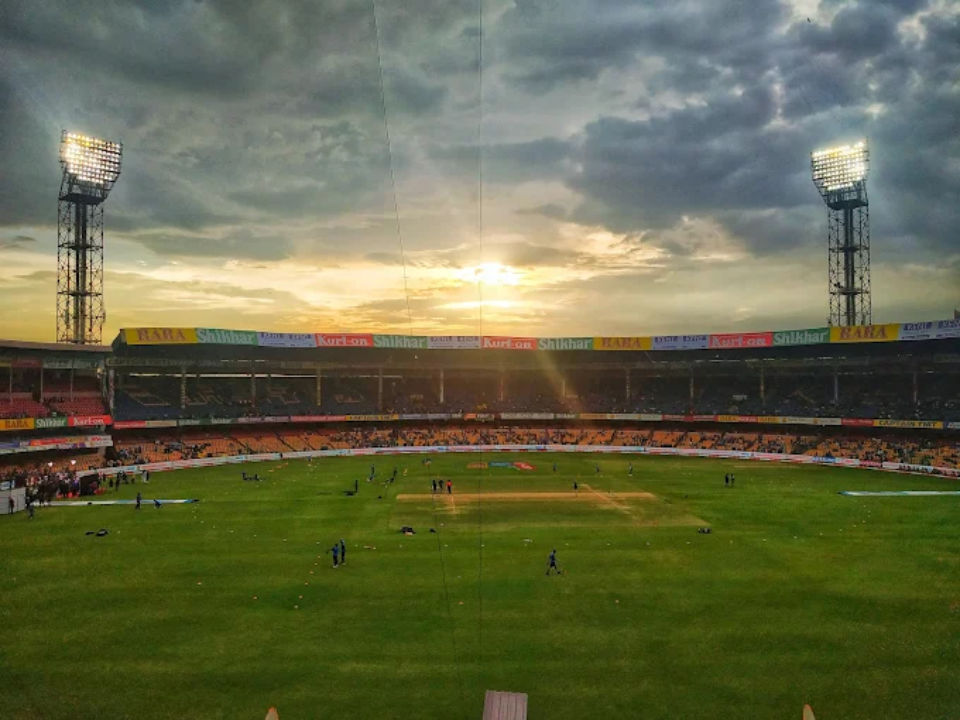
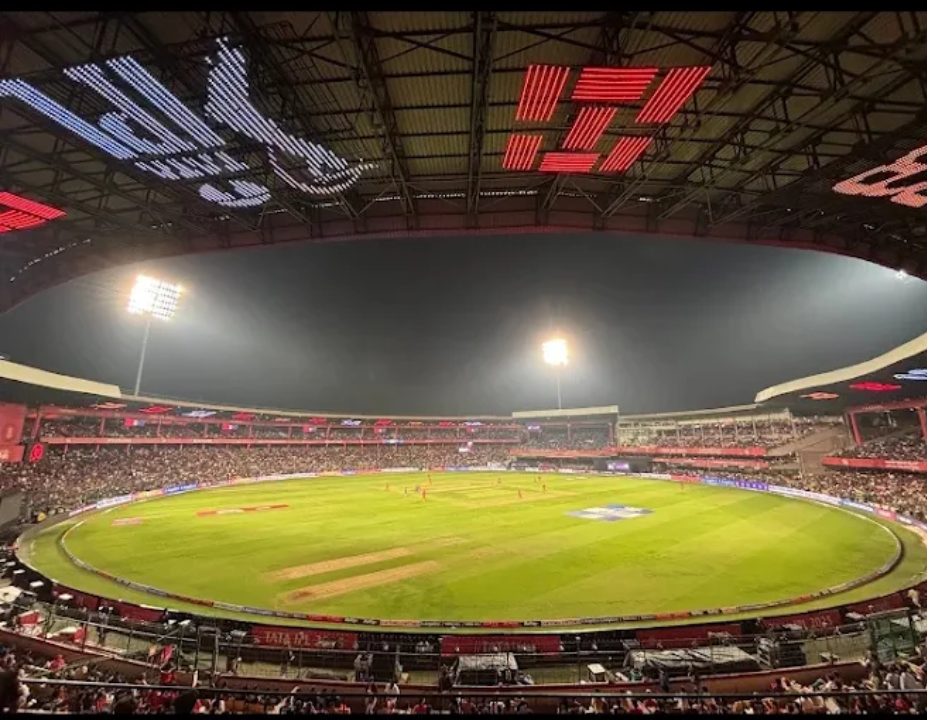
There is something about the M. Chinnaswamy Stadium, a certain kind of electric ambience every time there is cricket on show. Located in the very centre of Bengaluru, with Cubbon Park Forest on one side and MG Road upmarket energy on the other, this ground has an atmosphere unknown to Indian cricket. The resulting cry of the crowd when a Royal Challengers Bengaluru batter whacks one into the stands, that sound which travels around the arena like waves on open water, along with that light given off in the evening by the stadium lights, making the grass gleam, this is what gives Chinnaswamy its truly iconic cricket venue feel.
But that’s just mystical and emotional; this is turf where centuries have been notched up, records set and conditions that have gone on to make the careers of some of the greats in the game. This is the ultimate guide to everything you need to know about M. Chinnaswamy Stadium in 2026.
M. Chinnaswamy Stadium – Overview
| Detail | Information |
| Full Name | M. Chinnaswamy Stadium |
| Former Name | Karnataka State Cricket Association (KSCA) Stadium |
| Named After | Mangalam Chinnaswamy Mudaliar (former KSCA & BCCI President) |
| Location | Cubbon Park Road, Bengaluru, Karnataka, India |
| Established | Foundation stone laid in 1969; construction from 1970 |
| First International Match | November 1974 – India vs West Indies |
| Owned By | Government of Karnataka |
| Managed By | Karnataka State Cricket Association (KSCA) |
| Seating Capacity | 40,000 spectators |
| Home Team (IPL) | Royal Challengers Bengaluru (RCB) |
| Bowling Ends | Pavilion End and BEML End |
| Formats Hosted | Test, ODI, T20I, IPL, First-Class |
| Altitude | 920 metres above sea level |
| Floodlights Installed | 1996 (for the Wills World Cup) |
| Notable Feature | First cricket stadium in the world to use solar panels (2015) |
History and Origin of M. Chinnaswamy Stadium
The M. Chinnaswamy Stadium was established upon a foundation stone laid in 1969, with construction completed in 1970, with the Government of Karnataka’s donations. The ground was used for first-class cricket from the 1972–73 Ranji Trophy season and hosted its first international match when India played host to West Indies in November 1974, marking the international debut of the ground.
You were named the Karnataka State Cricket Association Stadium, a functional name which highlighted administrative control over character. It was then renamed after Mangalam Chinnaswamy Mudaliar, a lawyer from Mandya who co-founded the Mysore State Cricket Association and served as BCCI president. Renaming it was a tribute to his contributions while also providing the stadium with an identity befitting of the stature it was beginning to pull down.
There is another, more personal reason that Indian cricket fans are keen about the M. Chinnaswamy Stadium, it was the ground where West Indies legends Sir Viv Richards and Gordon Greenidge made their Test debuts; it is also where, in 2008, Sachin Tendulkar inaugurated a wall of bricks to honour Rahul Dravid, delivering an unheralded feat, his having scored 10,000 runs in Test and ODI cricket.
Location: M. Chinnaswamy Stadium
Also Read: Uday Saharan | Narendra Modi Stadium
The Go Green Initiative – A Stadium Paving The Way For The World
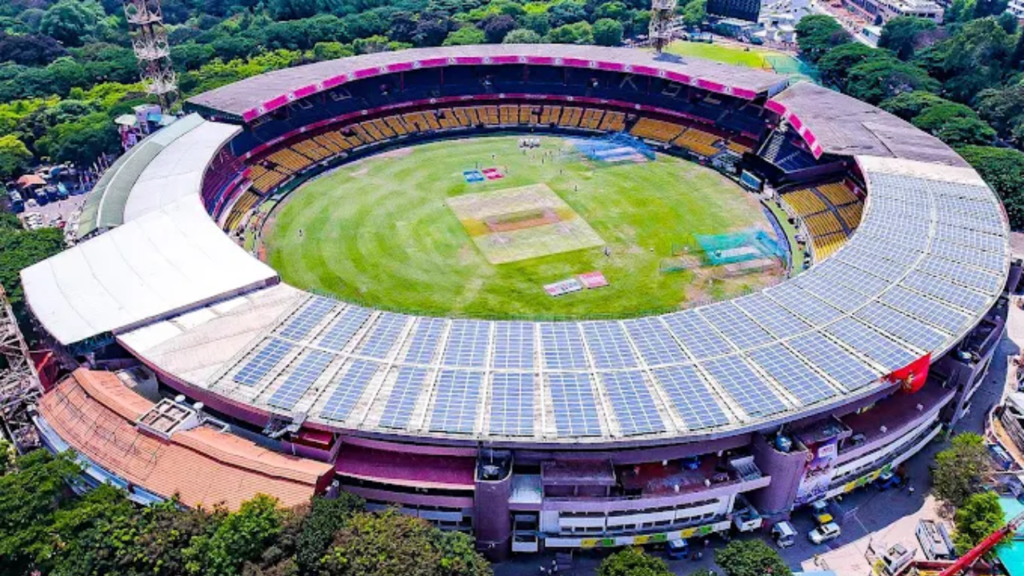
In 2015, M. Chinnaswamy Stadium set a world record with nothing to do with runs or wickets. To provide most of the electricity necessary to power the stadium, solar panels were fixed to parts of the stadium roof through a statewide initiative led by Karnataka State Cricket Association’s Go Green. This made Chinnaswamy the first cricket stadium anywhere in the world to use solar energy at scale for its operations, and it’s a claim that this ground wears with pride to this day.
The Go Green programme went beyond solar energy. A water purification plant was also added in 2016. And then in January 2017, a high-tech aeration and drainage system had been installed, meaning no more interrupted matches because of sodden outfield – although it was partially an environmental initiative by regulating water usage too. Combined, they have positioned Bishen Singh Bedi, who had declared the M. Chinnaswamy Stadium as a green leader in global cricket infrastructure, a ground that has taken its holistic responsibilities well beyond the boundary rope.
M. Chinnaswamy Stadium Pitch Report
To call the M. Chinnaswamy Stadium pitch a batting paradise would be the understatement of the century. It is prepared on a true, uniform flat surface, coupled with arguably the fastest outfield in India and square boundaries as short you’ll see anywhere on the international circuit; geography as much preparation apparently conspiring to deliver these big totals.
The altitude of 920 metres above mean sea level in Bengaluru is also significant when it is applied to the cricket ball. At that elevation, the air is thinner, which means there is less atmospheric drag and the ball carries through the air farther off the bat. At Chinnaswamy alot of good shots go for six which would have been caught just inside the boundary at other venues, particularly those with lower altitude.
The nature of the pitch is like across formats:
- Test cricket: First three days see batters dominating on a flat, true surface. Day 4 and beyond sees increasing help for spinners as the pitch wears and surface roughens up. The new ball in the first session, every day is prime fodder for pace bowlers.
- ODI cricket: Consistently high-scoring. Every now and then, teams cross the 300 run mark at this venue. It has also got the second-highest average first-innings total in ODIs at this ground (262).
- T20 & IPL Cricket: The most batting-friendly T20 ground in India IPL first innings average score around 168–181. 200 plus totals are the norm, and Sunrisers Hyderabad’s 287/3 against RCB in 2024 remains the highest team total ever recorded.
M. Chinnaswamy Stadium Boundary Dimensions
| Boundary | Distance |
| Straight (Pavilion End) | 70 – 75 metres |
| Straight (BEML End) | 68 – 72 metres |
| Square Leg | 61 metres |
| Cover / Point | 61 – 63 metres |
M. Chinnaswamy Stadium Weather and Best Time to Visit
The city of Bengaluru lies on the Deccan Plateau at an altitude that makes for one of the most temperate climates among Indian metropolitan areas. In fact, the weather at the M. Chinnaswamy Stadium, during even South India’s most sweltering summer months (March to May; which corresponds with IPL season), averages between 25°C and 34°C, much more comfortable. Cool evenings make for a very pleasant outing for spectators and players both during day-night matches.
Monsoon descends in June, and remains till September, which is why after monsoons Test cricket in October/November has the returns of a moist, slower outfield that takes some bite off a traditionally high-scoring wicket. With clear skies and mild temperatures, October to February is the best time to watch cricket at Chinnaswamy.
Dew is a significant factor in day-night IPL matches. With the temperature dropping, dew sets in and the outfield as well as the ball becomes harder to grip for spinners and pace bowlers. That is, again, one of the big reasons teams batting second at Chinnaswamy have an edge statistically, the ball comes on quicker, and when you try to keep hitting with an even below average score in terms of defence.
M. Chinnaswamy Stadium – All Format Records
IPL Records
| Record | Detail |
| Highest Team Total (IPL) | 287/3 – SRH vs RCB, 2024 |
| Lowest Team Total (IPL) | 82 – RCB vs KKR, 2008 |
| Highest Individual Score | 175* – Chris Gayle (RCB) vs Pune Warriors, 2013 |
| Best Bowling Figures | 4/9 – Samuel Badree (RCB) vs MI, 2017 |
| Fastest IPL Century | 30 balls – Chris Gayle vs Pune Warriors, 2013 |
| Highest Successful Chase | 213/9 – LSG vs RCB, 2023 |
| Average First Innings Score | 168-181 |
| Most IPL Runs at Venue | Virat Kohli – 3,100+ runs |
| Most IPL Sixes at Venue | Chris Gayle – 127 sixes in 44 innings |
| Most IPL Wickets at Venue | Multiple spinners and seamers in the top 5 |
| Total IPL Matches Hosted | 96+ |
| Teams Batting First Win % | 43% |
| Teams Batting Second Win % | 54% |
Test Records
| Record | Detail |
| Tests Played | 24 |
| India Wins | 9 |
| Opposition Wins | 6 |
| Draws | 9 |
| Highest Team Total | 626/9d – India vs Pakistan, 2007 |
| Lowest Team Total | 103 – Afghanistan vs India, 2018 |
| Highest Individual Score | 267 – Younis Khan (PAK) vs India, 2005 |
| Best Bowling (Innings) | 8/50 – Nathan Lyon (AUS) vs India, 2017 |
| Best Bowling (Match) | 11/224 – Harbhajan Singh vs Australia, 2004 |
| Highest Successful Chase | 262/5 – India vs New Zealand, 2012 |
ODI Records
| Record | Detail |
| ODIs Played | 30+ |
| Highest Team Total | 401/6 – New Zealand vs Pakistan, 2023 |
| Lowest Team Total | 156 – England vs Sri Lanka, 2023 |
| Highest Individual Score | 209 – Rohit Sharma (IND) vs Australia, 2013 |
| Best Bowling Figures | 5/31 – Yuvraj Singh (IND) vs Ireland, 2011 |
| Highest Successful Chase | 329/7 – Ireland vs England, 2011 |
| Average First Innings Score | 262 |
M. Chinnaswamy Stadium in IPL 2026
For IPL 2026, Royal Challengers Bengaluru used M. Chinnaswamy Stadium as their complete home ground, where all of RCB’s matches were staged during that season. RCB had developed the best home record in IPL history, they remained undefeated at Chinnaswamy through the league stage and won three straight with him at the venue, leading to playoff rounds, while defending their first Davidson Shield title.
As always, the home ground lived up to its reputation by serving as a high-scoring spectacle. Virat Kohli batted aggressively for a half-century in his side’s chase with 26 balls to spare against Sunrisers Hyderabad, in RCB’s opening home game of IPL, a clear pointer to the rest of the field. It was the same venue in Chinnaswamy, in the year 2026, that lived up to its reputation as a bat-dominating haven conducive to record-breaking.
How to Reach M. Chinnaswamy Stadium
| Mode | Details |
| Metro | MG Road Metro Station (Green Line) – approximately 10 minutes’ walk |
| By Road | Located on Cubbon Park Road; accessible via MG Road and Queen’s Road |
| By Rail | Bengaluru City Railway Station – approximately 4 km away |
| By Air | Kempegowda International Airport – approximately 40 km via elevated expressway |
| Parking | Limited in-stadium parking; the metro is strongly recommended for match days |
Also Read: Zahur Ahmed Chowdhury Stadium | Wankhede Stadium
Photos of M. Chinnaswamy Stadium
Conclusion
The M. Chinnaswamy Stadium, in stark contrast, is more than just another cricket ground; it is a vibrant museum of classic moments, a shrine that has seen legends walk the pitch and records broken, giving way to spectacular talent emerging from nearly a dozen different nations. From Brendon McCullum’s opening-night bloodbath in 2008 to Chris Gayle’s 175 in 2013, from the floodlit quarter-final of the World Cup in 1996 to RCB’s defending champions holding court in IPL 2026, this ground has consistently been where cricket writes its most thrilling chapters.
The M. Chinnaswamy Stadium, as the world’s first solar-powered cricket enclave and one of its higher-scoring joints, goes a long way to illustrate that an exceptional cricket ground is about much more than grass and rope, it’s about identity, history and the type of passion the game needs to be brilliant.
Frequently Asked Questions (FAQs)
1. How many seats are in M. Chinnaswamy Stadium?
It is a 40,000-seater stadium.
2. Which are the two bowling ends at Chinnaswamy?
The ground has two ends, named the Pavilion End and BEML End.
3. M. Chinnaswamy Stadium is home to which IPL team?
It serves as the home ground for Royal Challengers Bengaluru.
4. How is the Chinnaswamy Stadium pitch?
A high-scoring match will commence on a batting-friendly pitch, where the boundaries are short.
5. Was Chinnaswamy the first cricket stadium with Solar Power?
Yes, the cricket stadium became the first to harness solar energy back in 2015.